

SEO costs in New York City typically fall between $1,000 and $5,000 per month for small businesses, while enterprise programs can range from $10,000 to $30,000+ per month. Hourly rates often sit in the $100 to $250 band. That is the short version. The longer version is more nuanced, I think it should be, because budgets live or die on scope, competition, and the caliber of the team you hire.
Why do quotes differ so much, a few big levers decide the price. Your business size, the complexity of your website, the intensity of your market, and the experience of the agency or consultant. New York SEO agencies also carry higher overhead, which nudges fees up compared to lower cost regions. None of this means you must overspend, it means clarity pays off.
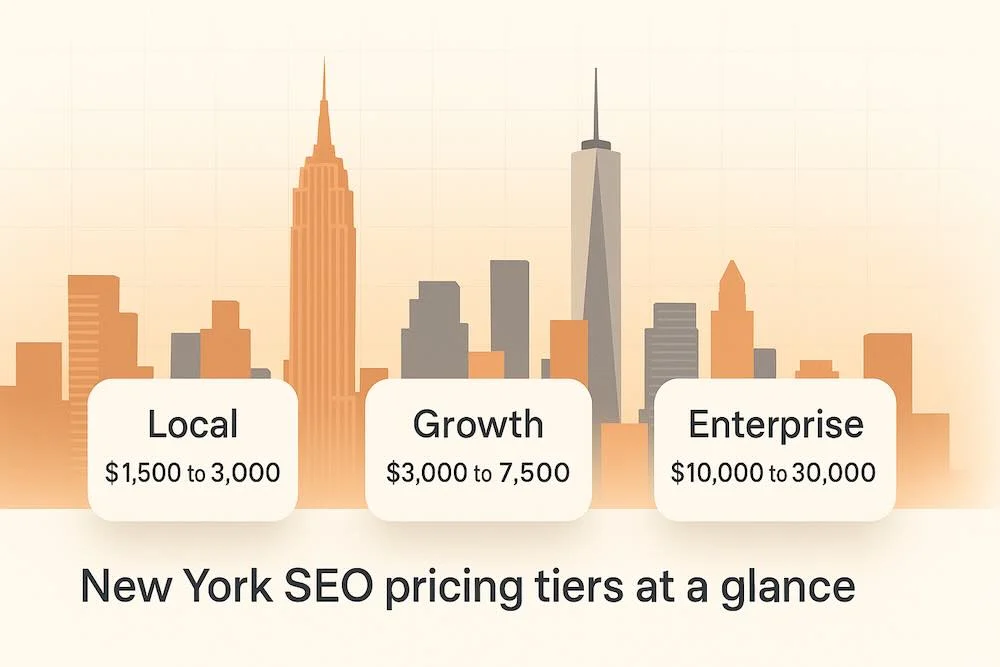
If you are a local service business, you might be fine in the $1,500 to $3,000 range, especially if the plan is focused, Google Business Profile, on page fixes, a modest content cadence. If you compete in law or finance or enterprise eCommerce, your requirements usually expand, more content, stronger digital PR, deeper technical work, and your budget follows. That is the reality of a crowded city with very smart competitors.
Common pricing models
Monthly retainers
The most common approach. You pay a fixed monthly fee for an agreed mix of strategy, execution, reporting, and meetings. In NYC, retainers often start around $2,500, mid market sits in the $3,000 to $7,500 zone, and competitive or enterprise programs move into $10,000 to $30,000+. Good retainers list deliverables by month as well as outcomes. If a proposal skips the first 45 days of actions, ask for them. It sounds fussy, perhaps, but clarity lowers risk.
Hourly rates
Useful for audits, training, advisory calls, and small tasks. A credible US based practitioner usually charges $100 to $250 per hour. Hourly is flexible. The trap is fragmentation, lots of small asks that never build momentum. I like hourly for discovery, then a retainer for compounding work.
Project based fees
One time engagements such as technical audits, keyword research, migration planning, and content blueprints. Expect $500 to $5,000+ depending on depth and site size. Projects are great to kick the tires on a provider. Just remember, projects do not replace the ongoing work that actually moves rankings and revenue, they point you to it.
Factors influencing cost in NYC
Business size and goals
A single location service company targeting a few neighborhoods, lighter scope. A multistate eCommerce brand with thousands of SKUs, heavier scope. If your goal is statewide or national visibility, or if you operate in multiple languages, the needed content and the technical surface area grow quickly, so does budget.
Industry competition
New York has crowded SERPs. Legal, finance, medical, hospitality, SaaS, each with layered buyer journeys. Competing here usually requires authority content, thoughtful digital PR, and ongoing technical stewardship. When I see a low quote for a high pressure vertical, I get nervous. Cheap does not mean efficient, it often means thin deliverables.
Scope of services
Basic local SEO covers citations, GBP, on page updates, and a light posting plan. Complete campaigns add content hubs, programmatic long tail, real PR and link earning, structured schema, CRO support, and analytics that tie to leads. As scope widens, costs rise, which is logical even if it is inconvenient.
Agency reputation and location
Top NYC agencies price for deep teams and speed. A smaller out of state provider may charge less, which can be a smart choice if the team shows they can ship on your stack. I am slightly torn here. Price is not the only signal. The people and their process matter more.
.
What you should expect for your investment
A small to mid sized NYC business that invests $2,500 to $8,000 monthly should expect a working mix of the following, with owners and dates attached to each item.
- Technical health, crawl and index management, Core Web Vitals, template fixes, and ticketing that actually gets shipped.
- Content velocity, at least 2 to 4 net new or refreshed assets each month, mapped to search intent, with internal links that carry weight.
- Digital PR and links, outreach that earns placements worth having, regional or industry, beyond directories.
- Local presence, GBP categories and services, photo cadence, UTM links, review strategy if you operate locally.
- Measurement, reporting tied to leads and pipeline where possible, alongside rankings and traffic.
- AI overview readiness, answer blocks written to be quotable, entity work to make your brand legible to models, periodic refreshes.
For enterprise budgets in the $10,000 to $30,000+ range, expect programmatic SEO with guardrails, larger editorial calendars, consistent PR campaigns, and regular collaboration with your dev and analytics teams. These programs feel like product development, they never really stop.
| Model | Typical NYC Range | Best For | Considerations |
|---|---|---|---|
| Monthly Retainer | $2,500 to $10,000+, enterprise $10,000 to $30,000+ | Ongoing growth, competitive markets | Define deliverables by month to avoid drift |
| Hourly | $100 to $250 per hour | Audits, training, targeted fixes | Fragmented ownership can slow progress |
| Project Based | $500 to $5,000+ per project | Discovery, migrations, content blueprints | Needs a retainer to compound results |
| Tier | Monthly Budget | Content Velocity | PR and Links | Technical Focus |
|---|---|---|---|---|
| Local Starter | $1,500 to $3,000 | 1 to 2 posts or page updates | Citations, local features, light outreach | Health checks, GBP, quick wins |
| Growth | $3,000 to $7,500 | 2 to 4 assets, plus refreshes | Thought leadership, selective placements | Templates, schema, Core Web Vitals |
| Competitive or Enterprise | $10,000 to $30,000+ | 4 to 8 assets, plus programmatic long tail | Monthly PR campaigns, high authority links | Continuous optimization, index control |
NYC SEO costs in practice, real scenarios and what you actually buy
Let’s get specific. Price bands make more sense when you can see how they line up with business types, growth goals, and the work involved. I will walk through four common NYC scenarios. I will also give you a quick RFP email you can send to two or three providers, plus a simple ROI calculator you can paste into Sheets. If something feels a bit repetitive, that is on purpose. Real planning benefits from gentle repetition.
Scenario 1, single location service business
Who this fits. A local practice or contractor that serves a few neighborhoods. Think Upper West Side, Harlem, Washington Heights. You want phone calls and form fills, not national fame.
Typical monthly budget. 1,500 to 3,000 dollars.
What you should get.
- Technical health checks, tracking, and fast fixes for the five or ten issues that actually move the needle.
- Google Business Profile optimization, categories, services, UTM links, photo cadence, and a simple review plan.
- On page improvements for top services, titles, H1s, schema, and internal links that point to the money pages.
- One or two content pieces per month. Short neighborhood pages or useful FAQs can be enough at this tier.
- Local listings and selective outreach. Aim for a few relevant features, not volume for the sake of volume.
- Reporting that ties traffic to calls and forms. Short, honest, readable.
Timing. Early signals within two to three months if the site is healthy. Tougher terms take longer. Not exciting, yet realistic.
Scenario 2, multi neighborhood or multi service firm
Who this fits. A professional service firm or clinic that needs visibility across Midtown, Brooklyn, Queens, and a few suburbs. More services to support. More pages to build.
Typical monthly budget. 3,000 to 7,500 dollars.
What you should get.
- Everything in Scenario 1, plus structured content hubs. Pillar pages that explain the service. Spokes that answer specific questions.
- Two to four net new or refreshed assets per month. Some months focus on new, some on updates that recover decay.
- Internal linking that is thoughtful, not automated spray. Use breadcrumbs, related links, and navigation that supports the hub.
- Digital PR that aims for selective features. Industry publications. Local outlets with real readers. No junk.
- Template level technical work. Pagination, schema coverage beyond basics, image compression, and Core Web Vitals targets.
- Lead source tracking and simple pipeline metrics. You want to know which pages lead to booked work.
Timing. Clear progress by month three or four if scope is tight and approvals are fast. I think approvals cause more delay than algorithms.
Scenario 3, highly competitive verticals
Who this fits. Law, finance, medical specialist, aggressive B2B in Manhattan. You are not chasing vanity terms, you are defending your market.
Typical monthly budget. 10,000 to 20,000 dollars. Sometimes more.
What you should get.
- Editorial calendar with four to eight assets per month, plus scheduled refreshes for anything that is slipping.
- Data backed content. Surveys, first party data, expert commentary. Pieces that are worth citing.
- Steady PR. Every month has a story, a quote, or a data hook. Outreach is consistent and measured.
- Conversion support. A few landing page tests, form tweaks, or offer experiments. Nothing wild, just steady improvements.
- Deep technical stewardship. Crawl budget management, index controls, and clean templates. Regular crawls. Small fixes shipped quickly.
- Model and AI overview readiness. Answer blocks that a model can quote. Entities that match your brand and services. A cadence for updates.
Timing. This is a long game. Early lift is possible. Defensible rankings that stick require patience and quality.
Scenario 4, enterprise and eCommerce
Who this fits. Multi location or multi country brands. Large catalogs. Complex site architecture. Stakeholders everywhere.
Typical monthly budget. 20,000 to 30,000 dollars and up.
What you should get.
- Programmatic SEO with strict guardrails. Long tail templates that are reviewed by humans. Index only what deserves to rank.
- Large scale content management. Net new content plus decay recovery. Editorial standards that match your brand.
- Consistent digital PR. Not five hundred links. A measured stream of strong placements that move authority.
- Engineering partnership. Tickets are written clearly. Rollouts are scheduled. Monitoring is continuous.
- Analytics that connect to revenue as well as sessions. If you cannot see the commercial signal, fix that first.
Timing. Ongoing. Think in quarters. The work starts to look like product development. It should.
How to compare two NYC proposals in 10 minutes
I use a simple points system. Every 30 minutes equals 1 point. Ask each provider to assign points to each deliverable. Then total points per month.
- Technical backlog, 8 to 12 points in month one, 2 to 6 monthly after that.
- Content production, 4 points per one thousand word draft including research and editing.
- Content refresh, 2 to 3 points per page depending on depth.
- PR initiative, 6 to 10 points for a small campaign or a focused pitch.
- Reporting and planning, 2 to 4 points.
Now compare totals. If one 5,000 dollar proposal equals 60 points and another equals 40, ask why. Maybe the higher one is padded. Maybe the lower one lacks content. This simple math exposes mismatches without a fight.
| Metric | Cell | Formula or Input |
|---|---|---|
| Average profit per lead | B2 | Input, for example 400 |
| Target new leads per month | B3 | Input, for example 25 |
| Monthly value from SEO | B4 | =B2*B3 |
| Planned SEO budget | B5 | Input, for example 5000 |
| Breakeven leads required | B6 | =B5/B2 |
Vendor selection checklist for NYC SEO, practical and a little opinionated
Choosing a partner in New York can feel noisy. Slick decks, big promises, similar price tags. Here is a checklist you can use to separate signal from noise. It is simple on purpose. You can print it, mark it up, hand it to your team.
1) Discovery and first 45 days
Ask for a written plan that covers the first 45 days. It should name five to ten actions, owners, and dates. If a provider cannot outline what happens in week one, you will feel that uncertainty later.
2) Content clarity
Request three content titles they would ship in month one and two, with target queries and intent. Ask where each piece will link to inside the site. Small detail, big impact.
3) Technical tickets
Have them list the first five tickets they expect to file. For example, index controls, template fixes, schema coverage, Core Web Vitals. Then ask how they will ship these on your stack. If they need a developer, who is that person.
4) Digital PR approach
Good PR is specific. Ask for one story angle, sample outlets, and how success will be measured. Beware of generic promises about hundreds of links. You want relevance and authority, not volume.
5) Reporting and attribution
Insist on reporting that connects work to leads. Traffic is useful, conversions are better. If phone tracking or form attribution is missing, results will be hard to judge.
6) Team and hours
Names matter. Who is your strategist, who writes, who implements. A light point system helps. Every 30 minutes equals one point. Total points per month make scopes comparable.
7) Access and velocity
Decide who publishes. If every change requires a long queue, velocity drops. Provide staging access with guardrails, then audit monthly. Trust plus accountability works.
8) Escalation plan
Ask what happens if results stall by day 90. Do they adjust scope. Do they propose a sprint. A clear answer here prevents frustration later.
9) Ownership and exit
Confirm that you own content, links, logins, and data. If you part ways, you keep work already completed. No confusion, no surprises.
Side by side deliverables table, three NYC tiers
| Deliverable | Local Starter $1,500 to $3,000 |
Growth $3,000 to $7,500 |
Competitive or Enterprise $10,000 to $30,000+ |
|---|---|---|---|
| Technical | Health checks and quick wins, tracking set up | Template fixes, schema, Core Web Vitals targets | Continuous optimization, index controls, crawl budget |
| Content | 1 to 2 posts or page updates | 2 to 4 assets plus refreshes | 4 to 8 assets plus programmatic long tail |
| Internal links | Manual links from core pages | Hub and spoke linking, breadcrumbs | Automated plus curated linking across templates |
| Digital PR and links | Citations and selective local features | 1 to 2 PR initiatives per month | Monthly PR campaigns with measurable placements |
| Local SEO | GBP categories, services, posts, review playbook | Location page system, photo cadence | Multi location governance and response workflows |
| Measurement | Traffic and conversions reported monthly | Lead attribution and assisted conversions | Pipeline and revenue alignment where possible |
| AI overview readiness | Concise answer blocks on core pages | Quarterly updates to answer sections and entities | Systematic entity work and ongoing test prompts |
A brief, honest workflow for month one in NYC
- Week 1, technical crawl, index status review, analytics check, and a priority list. Publish two or three quick wins.
- Week 2, write and publish the first hub page or refresh an existing one. Add internal links from the top five pages.
- Week 3, Google Business Profile overhaul if local, categories, services, UTM links, and two posts with fresh photos.
- Week 4, a small PR push, one story with a realistic list of outlets. Ship two content refreshes based on decay or missed intent.
Perfection is not the goal. Momentum is. Small shippable steps beat grand plans that sit in drafts.
Gentle contradictions to keep expectations realistic
Two thoughts that seem to disagree, yet both help. First, you do not need a huge budget to make progress in New York if your niche is narrow and your site is healthy. Second, cheap in a crowded market often costs more over time because you will redo thin content and weak links. Holding both ideas makes for better decisions.
I think scope discipline is the real open up. Choose three actions you can ship every month. Keep shipping. Review outcomes every quarter. Expand when you have proof.
Frequently Asked Questions
How much does SEO cost in New York in 2025?
SEO costs in NYC vary widely, small business retainers usually fall in the $1,000 to $5,000 per month range, while enterprise or highly competitive campaigns often reach $10,000 to $30,000+. Hourly rates are often in the $100 to $250 band. Costs depend heavily on scope, competition, site complexity, and agency reputation.
Why are NYC SEO rates higher than in other cities?
Because of higher overhead (rent, talent, operating costs) and stronger competition. Agencies in NYC often must deliver more polish and faster turnaround. Also, NYC verticals tend to be more aggressive (finance, law, real estate), so the baseline expectation is steeper.
What does a $5,000 per month SEO plan include?
Typically, that includes technical audits and fixes, content creation and refreshes (2-4 pieces monthly), internal linking strategies, local or regional SEO (if relevant), digital PR and link outreach, and reporting tied to leads and conversions.
Is it better to choose hourly, project, or retainer pricing?
Hourly is good for discrete tasks or audits.
Project-based works for migrations, cleanups, or one-off campaigns.
Retainer is best when you want ongoing, compounding growth.
You can mix them: e.g. do a project audit, then roll into a retainer for execution.
How soon will I see results from NYC SEO?
You might see early movement in technical improvements and content within 2 to 4 months. But for competitive terms, real traction often comes at month 6 to 12. SEO is cumulative, not instant.
How do I judge whether I’m overpaying for SEO services?
Ask for clarity in scope. Translate deliverables into hours or a points system. Compare what each proposal ships. If one $8,000 plan outlines vague promises and another $8,000 plan lists 12 named actions, the latter is safer. Also check their case studies, client retention, and sample metrics.
How does AI search / generative answers affect SEO costs and strategy?
This is a hot area. With AI Overviews and generative models surfacing direct answers, you now need to produce “answer ready” content (concise, factual, structured). This often pushes content, entity, and schema work higher in scope. As AI becomes more central, expect more work around: citations, structured data, and entity building
Do I still need link building in 2025, or is content enough?
Content is foundational, but in NYC’s competitive verticals, authoritative backlinks and PR still matter. For AI-driven summaries, high trust sources are more likely to be cited. So you’ll often need both: outstanding content plus link acquisition / digital PR.
Can I hire a low cost SEO and then switch later?
Yes, but be cautious. Low cost often means minimal effort, thin content, or borrowed links. If you switch providers, you may lose momentum, duplicate work, or need cleanup. Always insist on content and inroads as deliverables you retain.
How do I optimize for rising zero-click search and AI overviews?
Lead with clear, concise answer snippets (1 to 2 sentences) before deeper explanation.
Use numbered lists, FAQs, tables, structures that AI and Google can extract.
Mark up with schema (FAQ, Q&A, HowTo) so models know what to quote.
Build entity signals: consistent names, credentials, linked references.
Continuously test which content gets cited, and adjust your format and phrasing over time.
Keep reading