

Before we dive in, a quick why. Search is changing, obviously. People still type queries into Google, that will not disappear overnight, but more of those same questions are now asked inside chat interfaces and AI overviews. The result, the answer, often shows up without a classic ten blue links. That shift is exactly where Generative Engine Optimization, GEO, lives. It is not a buzzword, or at least I do not think it should be. It is a way of structuring and proving information so large language models and answer engines can confidently use it, then credit you, and ideally drive the click when users want to go deeper.
If you are weighing this against traditional search work, our comparison of SEO vs GEO and what to prioritize first sets the two side by side.
If you are completely new to search strategy, you might want a refresher on the basics first. Our SEO Toronto page is a good overview, and the SEO Pricing Guide 2025 can help you scope efforts and budget. If paid amplification is on your radar, the PPC Agency Toronto page covers how ads can support GEO testing and rapid data collection.
What is GEO
Generative Engine Optimization, GEO, is the process of making your content, data, and evidence easy for generative systems to find, parse, verify, and reuse in answers. Where classic SEO focuses on ranking documents in search results, GEO focuses on being the trusted building block inside generated responses, the sentence a model quotes, the source an AI overview cites, the link a chat assistant offers when the user asks for details.
A simple way to think about it, GEO makes three promises to the model.
- Findability, the model can discover your content consistently, through crawlable pages, feeds, and structured data that match how answer engines gather knowledge.
- Verifiability, claims on your page are backed by clear sources, transparent math, and up front facts, dates and definitions that reduce ambiguity.
- Reusability, information is chunked, labeled, and licensed in a way that is easy to lift into an answer with minimal post processing, which means your passage is more likely to be selected.
That sounds abstract, perhaps. In practice, GEO means writing with humans in mind, while adding machine friendly scaffolding, things like strong headings, concise definitions at the top of sections, canonical identifiers, consistent units, short tables that summarize key facts, and citations for statistics. It also means marking up entities, products, and FAQs with schema, and publishing data in small, linkable sections, so a model can quote only what it needs.
I will admit something a bit contradictory. The best GEO pages often feel very human. They read like a helpful guide, not a sterile database. Yet under the surface, they carry the features that answer engines love, clean structure, sources, definitions, and unambiguous labels. That is the balance we aim for here.
If you prefer a hands on partner, our About 2Marketing page explains how we combine content, technical SEO, and paid testing to validate what answer engines actually pick up, not just what we hope they do.
Quick outline of this guide
- What is GEO
- How GEO differs from SEO
- Why GEO is important
- Key benefits of GEO
- How generative AI and answer engines work
- How GEO works, step by step
- The future potential of GEO
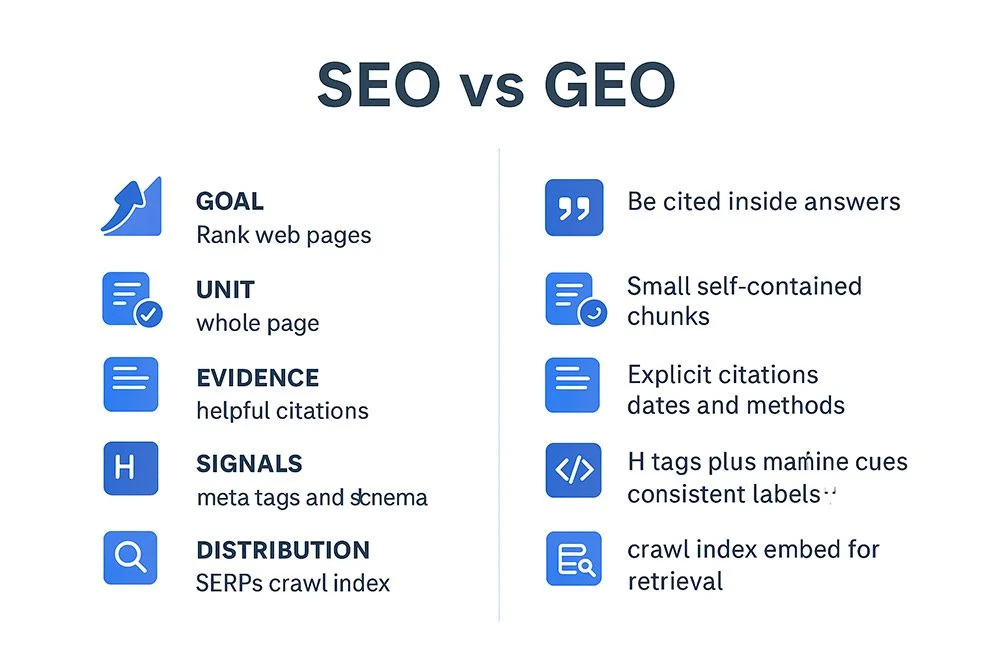
How GEO Differs From SEO
GEO and SEO feel like cousins who grew up in the same house, yet picked different careers. Traditional SEO optimizes a page to rank as a result. GEO optimizes information so it can be pulled, verified, and reused inside an answer. That subtle shift changes a lot, from how you structure content to how you prove claims. It even nudges your analytics mindset, because impressions look different when your sentence appears inside a generated summary rather than as blue link position six.
Here is a quick side by side to make it concrete.
| Dimension | Classic SEO focus | GEO focus |
|---|---|---|
| Primary goal | Rank web pages for queries | Be selected as a trusted passage or data point inside AI answers |
| Optimization unit | Whole page, sometimes section | Small, self contained chunks, definitions, tables, claims with sources |
| Evidence | Helpful, sometimes light citations | Explicit citations, dates, methods, dataset notes, even small formulas |
| Structure | H tags, internal links, helpful UX | H tags plus machine cues, consistent labels, ids, linkable fragments |
| Technical signals | Meta tags, canonical, schema | All SEO signals, plus fine grained schema, entity ids, content licensing |
| Distribution | Crawl and index in SERPs | Crawl, index, embed into model memory or retrieval systems |
| Measurement | Rankings, clicks, conversions | Mentions in AI answers, citation rate, assisted clicks, brand lift |
A practical example. In SEO, you might write a 2,000 word guide with a strong H1, solid H2s, internal links to your SEO Toronto pillar, and a conversion block. In GEO, you still do that, because humans, but you also add short, standalone definitions near the top, a table that summarizes key facts with units, a numbered method section that explains how you calculate a cost or benchmark, and precise citations. That makes it easier for an answer engine to lift your definition, or your cost formula, with confidence.
Another difference, language. SEO content can be narrative and persuasive, and that is great. GEO content benefits from occasional declarative sentences, simple, quotable lines. Think, a one sentence definition that would sound right inside a chatbot reply. This guide uses both on purpose. I like the mix, it feels more human, and it gives models clean seams to grab.
Licensing and reusability also matter more in GEO. If your site includes clear terms about how snippets can be reused with attribution, some answer engines treat that as a green light. You do not need to write legalese, keep it friendly, but explicit. A short note near your footer can work.
Finally, measurement. Ranking reports are still useful, no question, but you will add a second lens. Track when your brand appears as a cited source in AI overviews, or when a chatbot offers your link as the next step. You can do this with directional testing, brand lift surveys, and a bit of log analysis. If you want help instrumenting that, our About 2Marketing page explains how we blend analytics, PPC, and content experiments to see what answer engines actually use.
Why GEO Is Important
Short answer, GEO helps your brand become the sentence an answer engine trusts. That one line is worth pinning above your desk.
If search were only ten blue links, we could stop here and keep doing classic SEO. But user behavior keeps tilting toward conversational search, AI overviews, assistants that summarize before they list. Visibility now includes being named, quoted, or sourced inside an answer, not only ranking as a result below it. That is why GEO matters, practically, not theoretically.
I think about it in three layers.
- Distribution, your information travels further when it is machine readable, verifiable, and small enough to reuse. A tidy definition can show up in a chatbot. A clear formula can power a calculator.
- Attribution, citations are not guaranteed, yet they happen more often when your content is unambiguous, well structured, and clearly licensed.
- Action, when users want more, the assistant needs a logical next click. If you provide an obvious follow up page, you earn the click, not the vague aggregator.
The zero click reality
Zero click searches are not new, but answer engines intensify the pattern. A portion of users get enough from the summary, that is fine, brand imprint still matters. Another portion needs depth, pricing, location, nuanced use cases. You want your link, not a competitor, to be the offered next step. GEO nudges that decision by making your section the easiest to reuse, and your follow up link the most sensible.
Where GEO shows up today
This list changes, gently, but the idea holds.
- AI overviews in general purpose search results.
- Built in assistants in browsers and operating systems.
- Standalone answer engines that synthesize, then cite.
- Vertical assistants inside shopping, travel, or B2B tools.
- Voice interfaces that favor short, quotable definitions.
A quick table to anchor the thinking.
| Surface | What gets reused | Your GEO lever |
|---|---|---|
| AI overview | Concise definitions, short stats | One sentence definitions, small tables with units |
| Chat assistants | Steps, methods, comparisons | Numbered procedures, checklists, pros and cons blocks |
| Vertical engines | Specs, pricing, locations | Structured data, consistent ids, regional pages |
| Voice answers | Short explanations | Plain language, no jargon, declarative lines |
None of this replaces SEO. In fact, GEO rides on a well built site. If crawlability or UX is weak, reuse suffers. If you need a foundation check, start with an SEO audit conversation, then fold in content improvements. When speed testing or A or B experiments are helpful, our PPC Agency Toronto team can spin traffic to validate what gets cited, quickly. And budget guards the roadmap, so use the SEO Pricing Guide 2025 to scope phases without guessing.
A tiny thought on brand
There is a softer, brand level reason too. When an assistant repeatedly names your site as the source for a definition, users start to associate your brand with clarity. That association converts later, sometimes days later, which is awkward to attribute, but it is real. I have seen it. A small lift in direct traffic, an uptick in branded queries, even more time on page from referred users who arrive pre sold.
Metrics that make sense
You still track rankings and conversions, of course. Add these as directional checks.
- Citation rate in answers that mention your brand.
- Share of voice inside AI overviews for your key topics.
- Assisted click rate from answer engines to your logical next step.
- Brand lift, simple surveys work, or low friction polls on pages.
If you want a plan that ties GEO to pipeline, the About 2Marketing page outlines how we connect content, analytics, and paid sampling into one feedback loop. Or, if you prefer a quick start, contact us and ask for a GEO readiness sprint.
Key Benefits of GEO
Quick definition, GEO increases the chances that your words, not just your webpages, appear inside synthesized answers. That visibility, coupled with clear attribution paths, turns passive impressions into assisted demand. It sounds neat, sure, but the value is quite practical.
I like to group the benefits into two buckets, near term and compounding. Some wins show up quickly, others grow as your library matures.
Near term benefits
1) More appearances inside answers, even when you do not hold the top organic slot. When your definition or table fits perfectly, assistants tend to pick it. That is a new surface area for brand exposure.
2) Better attribution, because concise, sourced claims are easier to cite. You will not get credited every time, that is the honest part, but you will get credited more often when your content removes ambiguity.
3) Higher intent clicks, users who leave an answer to dig deeper usually want specifics. Pricing details, implementation steps, regional availability. If your page offers the obvious next step, your click quality improves.
4) Faster testing, answer engines react to clean structure and clarity. You can update a definition or a table, then sample traffic with light paid support to see if reuse ticks up. Our PPC Agency Toronto team often runs that loop so you are not guessing.
Compounding benefits
5) Insulation against SERP volatility, when layouts change, you still show up where summaries form. Not perfectly, but enough to smooth the bumps.
6) Content longevity, high quality, well sourced passages keep getting reused. A crisp definition can work for months. Sometimes longer. That is durable visibility.
7) Multi surface presence, the same chunk can power an AI overview, a chat reply, and a voice answer. One investment, several touchpoints.
8) Deeper trust, when assistants repeatedly associate your brand with clarity and citations, users arrive pre convinced. It shows up in soft signals first, then in pipeline, which is slower to measure, but it happens.
Here is a small table to anchor actions to outcomes.
| Benefit | Why it matters | What to publish |
|---|---|---|
| Answer share | More brand mentions inside summaries | One sentence definitions at the top of sections |
| Citation rate | Clear credit, more assisted clicks | Short, sourced stats with dates and methods |
| Click quality | Higher intent visits from answers | Obvious next step pages, pricing, regional variants |
| Testing speed | Faster learnings with fewer variables | Small tables, numbered methods, consistent ids |
If budget is a constraint, start with the pages that already drive conversions, then layer GEO elements there. The SEO Pricing Guide 2025 can help you phase the work in a way that fits your runway. If you want an audit that flags the easiest GEO wins, reach out through About 2Marketing and ask for a GEO readiness review. We pair content edits with light technical cleanup, internal linking to your pillars, and a simple distribution plan.
Two practical notes that keep paying back. First, make passages quotable. Short, declarative lines. Plain units. No jargon where a simple word works. Second, make fragments linkable. Clear H tags, stable anchors, consistent labels. If a model can grab a clean chunk, it usually will.
How Generative AI and Answer Engines Work
If GEO is the playbook, answer engines are the stadium. Understanding how they work, even at a high level, makes every content decision easier. I will keep this practical, not theoretical, although I might drift a bit, I tend to over explain when the plumbing matters.
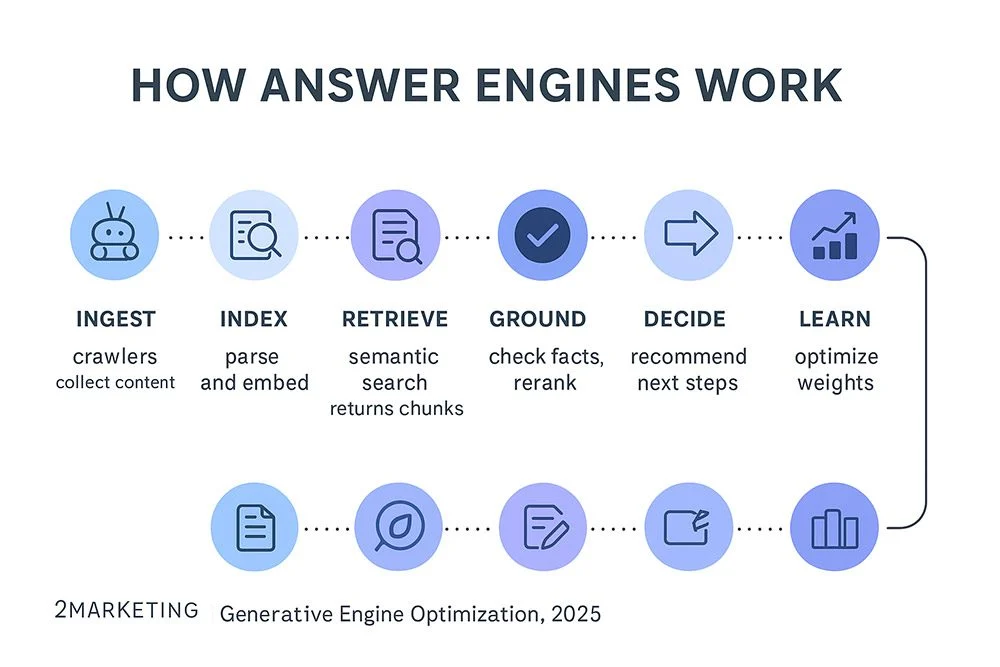
The core pipeline, simplified
Most modern answer engines follow a similar flow.
- Ingest, crawlers and connectors collect pages, feeds, PDFs, sometimes APIs.
- Index, content is parsed into chunks, embeddings are created, schema is read, entities are mapped.
- Retrieve, at query time the system pulls the most relevant chunks using semantic search, sometimes plus filters.
- Ground, the model checks facts against retrieved sources, reranks passages, and resolves conflicts.
- Generate, a large language model composes the answer, usually with citations, then post processing cleans tone and formatting.
- Decide, the engine chooses links or actions to offer as next steps.
- Learn, feedback loops adjust weights based on clicks, time to satisfaction, and simple user signals.
A table you can reuse with teams.
| Stage | What the engine needs | What you can publish |
|---|---|---|
| Ingest | Crawlable pages, stable URLs | Clean sitemaps, HTML that degrades gracefully |
| Index | Clear sections, entities, units | H tags, schema, consistent labels and ids |
| Retrieve | High semantic match | Plain language phrasing, synonyms in body copy |
| Ground | Verifiable claims | Citations, dates, methods, small formulas |
| Generate | Quotable snippets | One sentence definitions, short tables |
| Decide | Logical next steps | Obvious follow up pages with intent aligned CTAs |
| Learn | Signals of usefulness | Internal linking that keeps users progressing |
What counts as a strong signal
Answer engines love clarity. Three signals show up repeatedly in logs and vendor papers, and they map nicely to GEO habits.
- Unambiguous definitions, short, plain language. If a user asks what GEO is, your one sentence definition should fit neatly into a chat reply.
- Compact evidence, numbers with units, and a citation right there, not buried. Even a simple, Source, label helps.
- Stable structure, H2 and H3 sections that do not move or rename weekly, consistent anchors, and predictable table headings.
This is where classic SEO craft carries you. If your technical base is weak, retrieval suffers. If you need help debugging crawlability, URL structure, or page speed, start with an SEO audit, then layer GEO patterns. If you want traffic to validate changes quickly, our PPC Agency Toronto team can sample high intent queries so you see whether a new definition gets reused more often. Budget wise, the SEO Pricing Guide 2025 gives you realistic phasing.
Retrieval, the make or break moment
Perhaps the most misunderstood step is retrieval. If your passage is not retrieved, it cannot be cited. Retrieval is driven by embeddings and text similarity, which means two practical things. Write the way users speak, and include adjacent phrasing inside the same section. If your topic is GEO, mention answer engines, AI overviews, and chat assistants in that section. Do not stuff keywords, just be explicit. It feels almost too simple, but it works.
Grounding and contradiction
Models reconcile conflicts by preferring recent, well sourced, and internally consistent passages. If you publish a claim, give it a date, and, if it is a calculation, show the simple formula. I know, it looks like extra work. It is also your competitive edge. A small, legible method often beats a long, flowery explanation with no proof.
Generation and what gets quoted
Engines lift lines that are tight and portable. A clean definition, a bullet list of steps, a short pros and cons block. You will notice this guide mixes narrative paragraphs with quotable chunks on purpose. It reads like a human, yet it gives models clean seams to grab.
If you want strategy plus hands on implementation, our About 2Marketing page walks through how we plan, ship, and measure GEO work without getting stuck in theory.
How GEO Works
GEO is not mystical. It is a repeatable workflow you can run on a page, a hub, even a whole site. I like to frame it as seven steps. You can compress or expand as needed, of course, but the bones stay the same.
1) Choose the entity and the intent
Pick a focused entity, a concept, product, service, or process, and marry it to one clear user intent. For this page, the entity is Generative Engine Optimization, and the intent is definition plus application. Write that pairing at the top of your brief. It keeps the language tight and the structure honest. If you are unsure where to start, begin with the topics that already drive pipeline, then expand outward. If the technical base needs a tune up first, consider a quick SEO audit so crawlability does not block reuse later.
2) Design fragments, not just pages
Break the topic into small, linkable chunks that an answer engine can lift. Each H2 should address one sub intent, and each H3 should contain a self contained passage, a definition, a numbered method, a table, or a concise pros and cons block. Give every fragment a stable anchor and a predictable label, for example, #definition, #benefits, #method, #faq. Avoid renaming anchors casually. Stability is a quiet superpower.
3) Write human first, model friendly
Lead each fragment with one quotable line. Follow with context that reads naturally. Mix sentence lengths. Allow the occasional hesitation, perhaps or I think, if it mirrors how a real expert would talk. Use simple units and avoid jargon when a plain word works. If a calculation appears, show the tiny formula. If a claim might be contested, add the date scope so the model can judge freshness.
4) Add evidence and micro markup
Mark up the page as an Article, and where it makes sense, add FAQPage or HowTo. Keep it short and accurate. A tiny example that answer engines love to see.
<script type=”application/ld+json”>
{
“@context”: “https://schema.org”,
“@type”: “HowTo”,
“name”: “How to apply GEO on a service page”,
“step”: [
{“@type”: “HowToStep”, “name”: “Define the entity and intent”, “text”: “Pick one service and one user intent.”},
{“@type”: “HowToStep”, “name”: “Create linkable fragments”, “text”: “Draft H2 and H3 sections with anchors and one sentence definitions.”},
{“@type”: “HowToStep”, “name”: “Add evidence”, “text”: “Provide dates, methods, and compact tables with units.”}
]
}
</script>
If you publish stats, place the source right next to the number. Not buried. If you allow reuse with attribution, say so in plain language near the footer. Friendly, but explicit. This reduces ambiguity when an engine decides whether to cite you.
5) Publish for ingestion
Ship clean HTML that degrades gracefully, with a complete XML sitemap, plus an HTML sitemap for humans. Ensure canonical URLs, consistent trailing slash behavior, and compression. If your site has a knowledge hub, add a simple index.json feed that lists titles, anchors, short summaries, and last updated dates. That feed is optional, but it often helps retrieval systems find the freshest fragment.
6) Distribute and sample
Nudge discovery with sensible internal links from your pillars, especially your SEO Toronto hub. Use light paid sampling to test if your new definition or table gets reused more often. Our PPC Agency Toronto team often pairs a content change with a small traffic burst so we can watch for citations and assisted clicks without waiting months.
7) Measure and iterate
Track three things consistently, retrieval, reuse, and result. Retrieval is whether your fragment appears in semantic matches for target queries. Reuse is whether assistants cite or surface your passage. Result is the assisted click quality to your logical next step. Update the definition if it feels fuzzy. Tighten table headings if a unit is unclear. Small edits can move reuse more than you expect.
If you want a packaged sprint, the About 2Marketing page outlines how we plan and ship GEO work alongside classic SEO so you do not trade one for the other.
The Future Potential of GEO
Short version, GEO will blend into how we build and measure content, the way SEO did a decade ago. It will not replace SEO, it will sit beside it, then, bit by bit, feel inseparable.
Three shifts seem likely.
1) From pages to packages, answer engines prefer tidy, reusable units, so more brands will publish mixed media packages, a definition, a short explainer, a table, and a downloadable snippet, all under one H2. That sounds like a minor formatting tweak, but it nudges everything, how you brief writers, how you name anchors, even how you run QA. I think we will see more micro feeds too, simple index.json files that expose those fragments for ingestion, not a giant API, just enough metadata to help retrieval.
2) From static claims to living facts, models reward freshness when it is relevant. That pushes teams to date sensitive facts with version notes, then update in place. We already do this with pricing pages and comparison guides. Expect it to spread to stats, benchmarks, and definitions that evolve. The cadence will vary, no need to overdo it, but a light maintenance loop keeps your passages competitive.
3) From anonymous reuse to explicit attribution, not everywhere, but in more places. As ecosystems mature, assistants that show their work tend to gain trust. Clear citations, human visible and machine readable, become a feature users expect. Your job is to make attribution effortless, short source notes near numbers, sensible licensing language, and anchors that land exactly where the quoted line lives.
Here is a simple forecast table you can share with stakeholders.
| Horizon | What changes for teams | What to start doing now |
|---|---|---|
| Next 3 to 6 months | More AI overviews, more chat answers | Add one sentence definitions and compact tables to high value pages |
| 6 to 12 months | Better citation patterns, early brand lift signals | Add source notes next to numbers, stabilize anchors and labels |
| 12 to 24 months | Retrieval gets smarter about entities and regions | Publish clear entity ids, create regional fragments with consistent specs |
Two possibilities I am watching, with an honest caveat. They might arrive slower than we hope.
- First click economics, assistants may begin to share traffic more deliberately with sources that consistently improve satisfaction. If your passage reduces follow up questions, you get surfaced more often. It is plausible. Measuring it will be messy at first, and that is fine.
- Declarative site profiles, publishers could provide a compact file that declares expertise areas, preferred names for entities, and reuse terms. Think of it as a mini knowledge card at the domain level. Not mandatory, but helpful, especially for B2B sites with dense taxonomies.
What does all this mean for your roadmap, practically, not theoretically.
Start small, on the pages that already move revenue. Add human friendly definitions and compact evidence, then watch for reuse in AI answers. If you see early lift, roll the pattern to your supporting content. When budget allows, use light paid sampling to validate faster, our PPC Agency Toronto team does this a lot because it turns hunches into data. If you prefer a guided sprint, the About 2Marketing page explains how we pair content edits with technical scaffolding so answer engines can actually find and trust your fragments. And if you need to phase work sensibly, the SEO Pricing Guide 2025 lays out realistic ranges so you are not guessing.
One last, slightly contradictory thought. The best GEO content reads like it was written for people, not models. It tells the truth plainly, then shows a little of its work. Assistants recognize that tone. Users do too. Sometimes they cannot name why a page feels trustworthy, they just stay longer. Which is the point.
Closing notes, the one minute summary
GEO helps your brand become the sentence an answer engine trusts. You still need solid SEO, clean crawl paths, good UX. Then you layer fragments that are easy to retrieve, verify, and reuse. Short definitions. Compact tables. Clear methods. Friendly licensing. I think the simple rule is, write for people, then show a little of your work for machines. Assistants notice. Users do too.
If you want help prioritizing the first ten pages to upgrade, start with an SEO audit, skim our SEO Pricing Guide 2025 to set budget, and loop in PPC support for quick sampling. Or just contact 2Marketing and ask for a GEO readiness sprint.
GEO checklist, copy and run
Plan
- Pick one entity and one intent per page.
- Write a one sentence definition at the top of each H2.
- List adjacent phrasings users might type, include them naturally.
Structure
- Use clean H2 and H3 sections with stable anchors, for example, #definition, #benefits, #method, #faq.
- Add a small table for facts with units, keep headers predictable.
- Place the obvious next step link near each fragment, pricing, regional page, calculator.
Evidence
- Put dates next to time sensitive claims.
- Show tiny formulas for calculations, nothing fancy, just enough to be audit friendly.
- Add a short source note beside each number, not buried.
Technical
- Ship valid HTML, XML sitemap, canonical tags, predictable trailing slash behavior.
- Add Article schema, consider FAQPage or HowTo where it truly fits.
- If you can, publish a lightweight index.json listing fragments, anchors, summaries, last updated.
Measurement
- Track retrieval, reuse, result, semantic coverage, citations, assisted clicks.
- Use small paid bursts to validate changes, then roll out the winners.
A quick mapping you can share with writers.
| Page type | Must have fragments | Obvious next step |
|---|---|---|
| Definition guide | One sentence definition, compact comparison table | Link to service page or pricing |
| How to tutorial | Numbered steps, checklist, pitfalls | Link to consultation or template download |
| Location page | Service scope, regions, hours | Link to contact or booking |
| Comparison page | Side by side table, pros and cons | Link to recommendation or quiz |
If you need a partner to implement this across a hub, our About 2Marketing page outlines how we mix content, technical cleanup, and paid sampling without bogging teams down.
FAQ, GEO and SEO
What is Generative Engine Optimization, in one line
GEO is the practice of making your information easy for answer engines to retrieve, verify, and reuse inside answers, with credit whenever possible.
Is GEO a replacement for SEO
No, GEO builds on SEO. You still need crawlability, internal linking, and strong UX. GEO adds fragments and evidence so assistants can quote you confidently.
Do I need schema for GEO to work
Strictly speaking, no. Practically, schema helps machines understand structure. Use Article site wide, and add FAQPage or HowTo only when accurate.
How do I measure success if there is no classic ranking
Track citation rate in answers that mention your brand, assisted clicks to your logical next step, and share of voice inside AI overviews for priority topics.
How often should I update GEO fragments
Quarterly is fine for evergreen topics. Monthly for fast moving stats or pricing. If a fact is time sensitive, add the date next to it and review on a schedule.
Can a small site win against big brands
Yes, with clarity. A crisp definition and a verifiable table often beat a long page with fuzzy claims. Assistants reward unambiguous, portable snippets.
Should I allow reuse by AI tools
If you want to be cited more often, yes, with attribution. State reuse terms in plain language near your footer. If you prefer to restrict use, say that too, just know it may reduce selection.
Below is optional FAQ schema you can adapt. Keep it honest and aligned with the visible content.
<script type=”application/ld+json”>
{
“@context”: “https://schema.org”,
“@type”: “FAQPage”,
“mainEntity”: [
{
“@type”: “Question”,
“name”: “What is Generative Engine Optimization?”,
“acceptedAnswer”: {
“@type”: “Answer”,
“text”: “GEO is the practice of making information easy for answer engines to retrieve, verify, and reuse inside answers.”
}
},
{
“@type”: “Question”,
“name”: “Is GEO a replacement for SEO?”,
“acceptedAnswer”: {
“@type”: “Answer”,
“text”: “No, GEO builds on SEO. It adds fragments, sources, and structure so assistants can quote your page confidently.”
}
},
{
“@type”: “Question”,
“name”: “How do we measure GEO success?”,
“acceptedAnswer”: {
“@type”: “Answer”,
“text”: “Track citations in answers, assisted clicks to next step pages, and share of voice inside AI overviews for target topics.”
}
}
]
}
</script>
Ready to put GEO to work
Turn your content into the source answer engines trust. Tell us your goals, we will map a GEO readiness sprint, align budget, and start testing quickly. Contact us to get started.